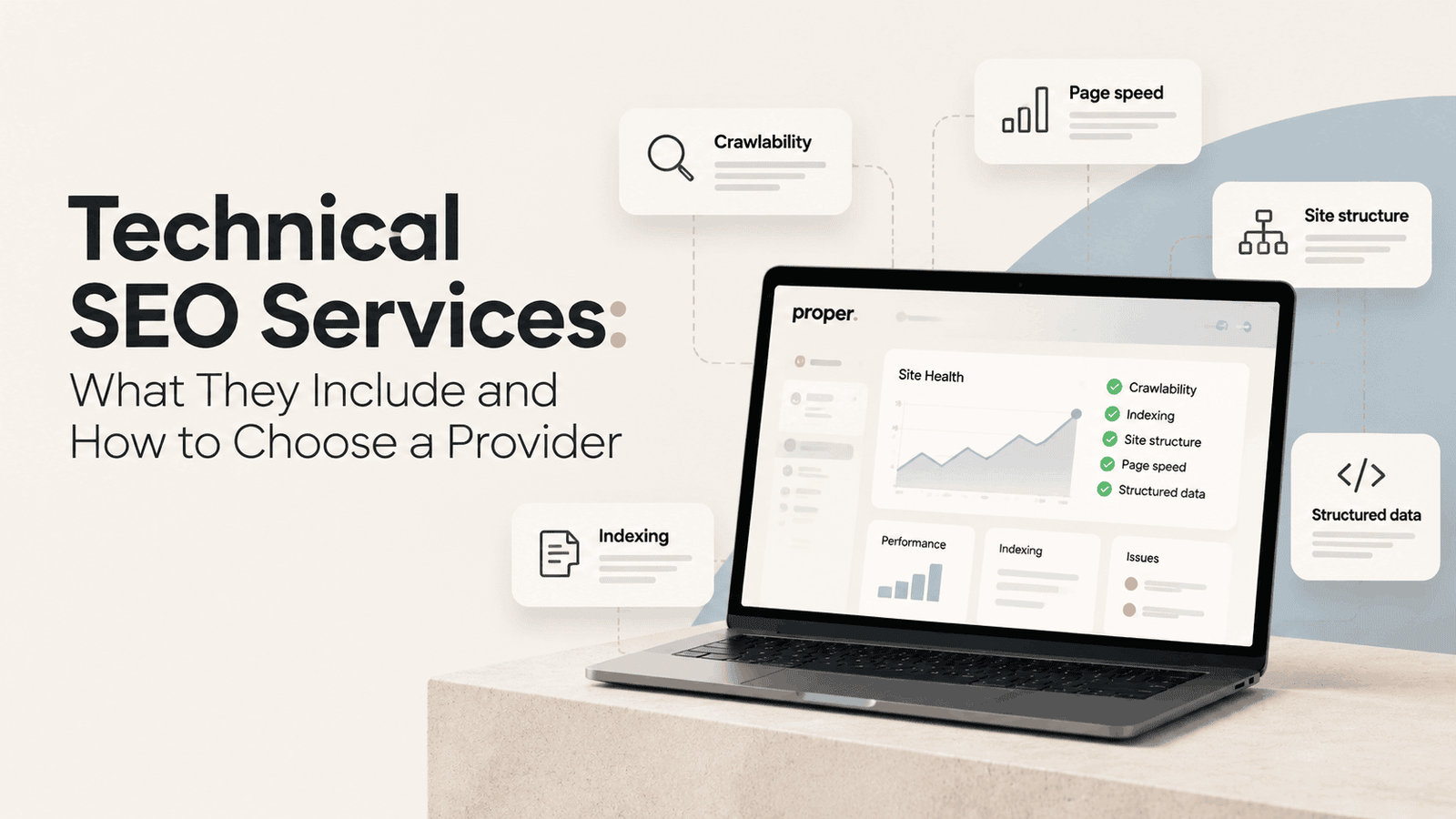
Your website can look great and still have problems that make it difficult for search engines to find and index your pages. Technical SEO services help identify and resolve those issues, giving your content a stronger foundation to perform in search.
But when you’re hiring a provider, it isn’t always clear what you’re paying for. Does the service include fixing problems or just finding them? Which issues deserve attention first? And how will you know the work made a difference?
You don’t need a technical background to assess a proposal. You need to understand what’s included, who’s responsible for the fixes and how the results will be checked.
What technical SEO actually means
Technical SEO helps search engines find, crawl, understand and index the important pages on your website. It addresses problems with how your site is built and organized that can limit its visibility in search.
On-page SEO focuses on your content and how well it matches what people are searching for. Off-page SEO focuses on signals such as links and reputation. Technical SEO supports both by making your website easier to access and navigate.
Some improvements are noticeable, like faster loading times. Others happen behind the scenes, such as correcting a setting that keeps a service page out of search results. The value comes from resolving issues that affect pages your business depends on.
What technical SEO services usually cover
The scope varies by website, but most technical SEO services cover a few core areas. A proposal should explain which ones need attention on your site and why.
- Crawlability: Can search engines access your important pages? Blocked resources, broken internal links and pages that are difficult to reach can interfere with crawling.
- Indexing: Can your important pages appear in search results? A review checks whether pages are excluded and investigates issues such as incorrect indexing directives or conflicting canonical signals.
- Site structure and internal links: Can visitors and search engines move easily between related pages? A clear hierarchy helps people find what they need and gives search engines context about your content.
- Speed and Core Web Vitals: Does the site load quickly, respond to interactions and stay visually stable? Large images, heavy scripts and server performance can all affect the experience, especially on mobile.
- Structured data: Does the site provide accurate, relevant information in a format search engines can interpret? Structured data can support eligible search features, but it doesn’t guarantee rankings or enhanced results.
If you’d like to review the basics before hiring someone, our technical SEO checklist for 2026 explains what to check and where to start.
What a good engagement looks like
A useful audit gives you a plan, not just a long list of warnings. Your provider should explain what matters, handle or coordinate the fixes and check the work afterward.
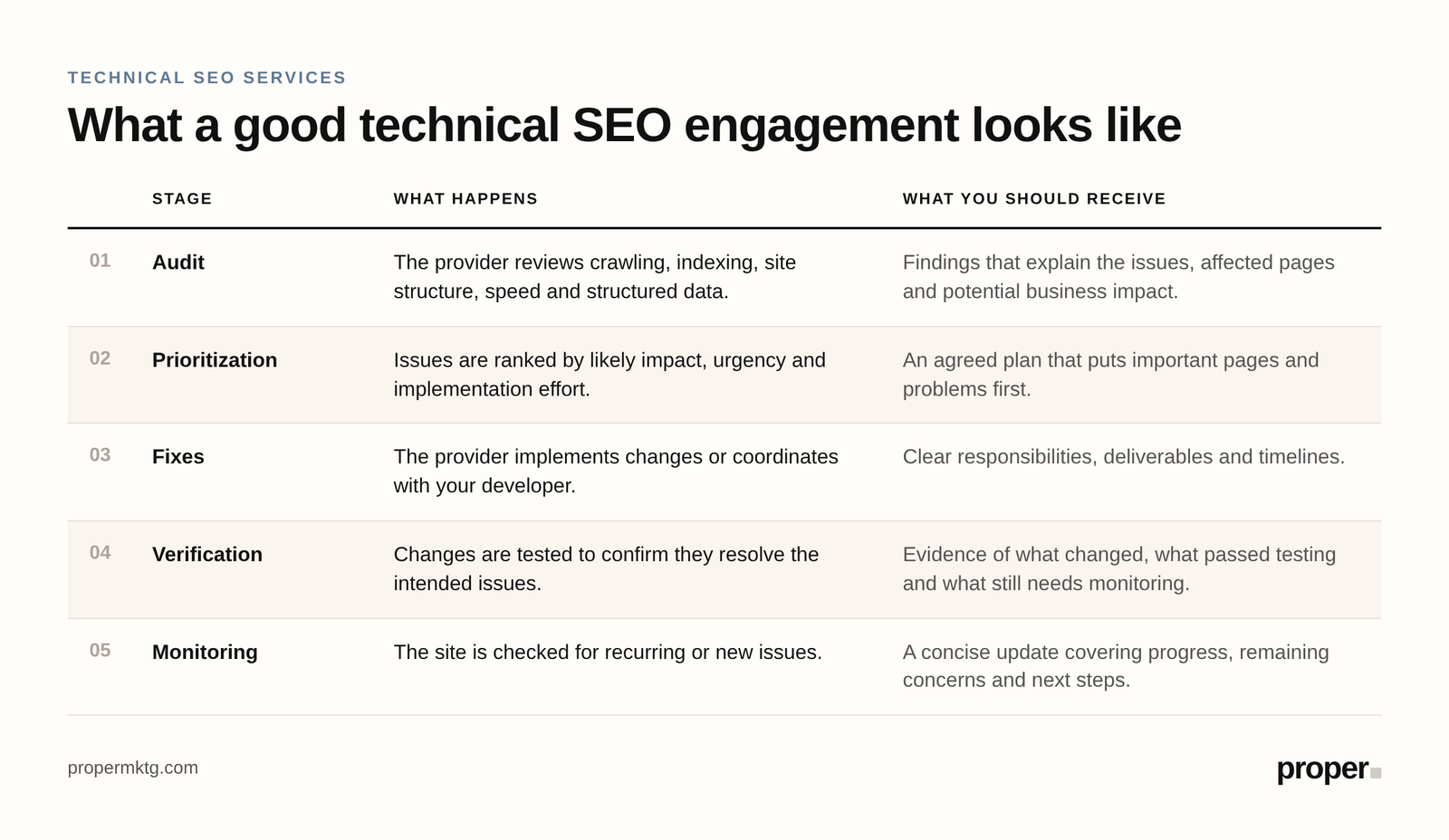
Not every website needs an ongoing engagement. A smaller, stable site may benefit from a focused project, while a larger site with frequent changes may need regular support.
What changes the scope (and the cost)
Comparing technical SEO services by price alone can be misleading. One proposal might cover an audit, while another includes implementation, testing and ongoing monitoring. The biggest factors affecting scope are:
- Site size and complexity. A small service website requires a different approach from an online store with thousands of product URLs.
- Site history. Previous redesigns, migrations and platform changes can leave behind redirects, duplicate pages and other issues that need investigation.
- Implementation responsibilities. An audit with recommendations is a different deliverable from a service that includes fixing the problems. Confirm whether development work is included.
- Ongoing support. A one-time cleanup addresses a defined set of issues. Regular monitoring helps catch problems as the website changes.
Before comparing prices, check that each provider is quoting for comparable work. A lower fee may simply mean more of the implementation falls to your team.
Questions to ask before you hire anyone
These questions help you understand both the proposal and what working with the provider will involve:
- What exactly will you audit, and how will you present the findings?
- Which pages would you prioritize, and why?
- Who implements the fixes: your team or mine?
- How will you verify that the changes worked?
- What’s included each month after the initial audit?
- Is there a minimum term or notice period?
- Can you explain the main issues in plain language?
You should leave the conversation understanding what needs attention and what happens next. If the explanation is mostly jargon or tool scores, ask the provider to connect the findings to specific pages and business priorities.
Signs your site may need technical SEO
Some website problems warrant a closer technical review:
- Organic traffic dropped after a redesign or domain migration.
- Pages that previously attracted visitors have lost visibility.
- Important service pages aren’t appearing in search.
- The website loads slowly or shifts around on mobile.
- Multiple URLs show the same or nearly identical content.
- New pages consistently struggle to get indexed.
These symptoms don’t prove the cause is technical. They give a provider a starting point for investigation. A useful assessment should distinguish technical issues from problems with content, competition or search demand.
Where technical SEO stops
Technical SEO helps make your pages accessible and eligible to appear in search. It doesn’t guarantee that they’ll rank well or bring in qualified leads.
Your content still needs to answer relevant questions, explain your services and give potential customers a reason to choose you. Competition, reputation and the quality of other search results also matter.
A responsible provider should explain which problems technical work can address and where broader SEO work is needed. Promises of specific rankings or guaranteed lead numbers deserve scrutiny.
How Proper approaches technical SEO
Proper is a boutique digital marketing agency based in British Columbia. We help clinics, professional services and wellness businesses improve their search presence through technical SEO, keyword and search intent research, on-page optimization, content strategy and AI search visibility.
Our approach starts with understanding your business and the pages that matter most to it. From there, we identify what’s limiting performance, prioritize the work and explain our recommendations in plain language.
You can explore our medical courier SEO case study or browse our work to see examples of our broader website and SEO projects.
Not sure whether your website needs technical fixes, stronger content or both? Book a free consultation to discuss what you’re seeing and which next steps make sense for your business.
Frequently Asked Questions
How is technical SEO different from regular SEO?
SEO includes several areas, such as content, keywords, internal links and reputation. Technical SEO focuses on how your website functions: whether search engines can access and index your pages, how the site is organized and how well it performs. It supports your other SEO efforts by addressing technical barriers.
Do I need technical SEO services if my website is small?
A small website can still have issues that affect search visibility, including blocked pages, slow loading times or incorrect redirects. The scope should match the site. You may need a focused review and a few targeted fixes rather than an extensive monthly service.
Can technical SEO fix a Google penalty?
It depends on the issue. If your site has a manual action, Google Search Console’s Manual Actions report explains the reason. Resolving it requires addressing the specific violation and requesting a review when appropriate; technical SEO may be part of that work.
A traffic drop after an algorithm update is different from a manual action and may require a broader review of content, quality and technical performance. Neither situation comes with a guaranteed recovery timeline.
How do I compare proposals from different agencies?
Start with the deliverables. Check whether each proposal includes an audit, implementation, verification and ongoing monitoring. Confirm who makes the changes and whether development costs are included.
Then ask how the agency prioritizes findings and measures progress. A strong proposal should help you understand what you’re buying, why the work matters and what your team will need to contribute.