
Let’s get this out of the way: there is no fixed price for SEO. Small business SEO cost depends on four things: what you want to achieve, the shape your website is in, how competitive your market is, and how much work it takes to get you there. Anyone who quotes you a number before looking at those is guessing.
I know. “It depends” is the most annoying answer in the world when you just want a number to put in your budget. But stick with me, because once you understand what actually drives the price, you’ll be able to look at any SEO proposal and know right away whether it makes sense for your business or not.
Why SEO Doesn’t Come With a Price Tag
Think about hiring a contractor to renovate a house. Nobody serious gives you a price over the phone without seeing the place first. A small bathroom refresh and a full kitchen rebuild are both “renovations,” but they’re nowhere near the same job.
SEO works the same way. A new bakery with a five-page website and one location needs a very different plan from a clinic with three locations, hundreds of pages and strong competitors down the street. Same service name, completely different amount of work.
So if someone sends you a package price before asking a single question about your business, that’s your cue to be careful. A good provider asks first, looks at your site, and only then recommends a scope.
What Shapes Small Business SEO Cost
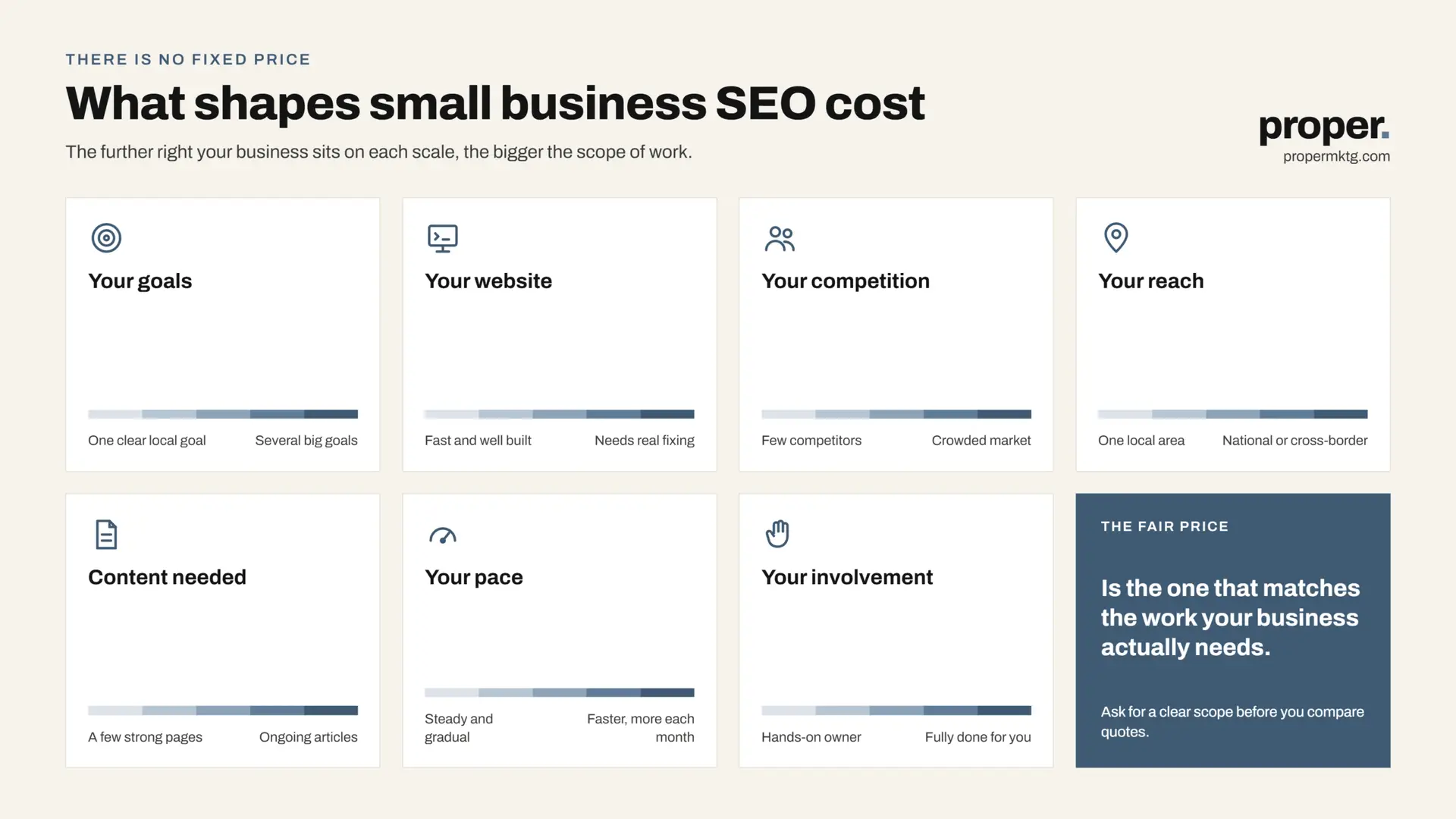
Here’s what really moves the number. Once you see these, “it depends” starts to make a lot more sense.
What you want to achieve
This is where everything starts. Do you want more calls from people nearby? More bookings for one specific service? More online sales across Canada and the US? Each goal leads to a different mix of work. Getting found locally leans on your Google Business Profile, reviews and local pages. Reaching customers nationally takes more content and tougher keywords. The clearer your goal, the more focused (and efficient) your plan can be.
The shape your website is in
If your site is fast, works well on phones and is already well organized, great. Less foundation work. If it’s slow, missing pages for the services you sell, or built years ago and never touched again, the first months will go into fixing what’s holding it back. There’s no point decorating a house with a cracked foundation.
How crowded your market is
Ranking for “accountant” in a small town is one thing. Ranking for it in Toronto or Los Angeles, where dozens of firms are fighting for the same searches, is a whole different game. More competition means more work to earn your spot.
Local or wider reach
Local SEO is all about helping nearby customers find you: the map results, your business profile, reviews and consistent business info across the web. Going wider, across a region or a whole country, usually means more content and more keywords to cover. Lots of small businesses start local and grow from there, and honestly, that’s often the smartest move.
How much content you need
This one is usually the biggest variable. Some businesses just need a few really solid service pages. Others need regular articles that answer customer questions and build authority over time. Creating content takes real work, so a plan with ongoing content will naturally be bigger than one that only polishes what you already have.
How fast you want to move
SEO is a long game either way, but the pace can change. If you want to cover more ground sooner, there’s more work to do each month. If you’re fine with a steadier pace, the same work can be spread out over a longer period.
How hands-on you want to be
Some owners love being involved: sending photos, reviewing drafts, sharing what customers ask all the time. Others want to hand it all over and focus on running the business. Both are totally fine. Just know that the more the agency does for you, the bigger the scope.
What You’re Actually Paying For
Every plan is different, but most are built from some combination of these:
- Technical SEO: fixing the stuff that stops Google from finding and understanding your pages
- Keyword and search intent research: figuring out what your customers actually type into Google
- On-page optimization: improving titles, headings and copy on the pages that bring in business
- Content: creating or improving pages and articles that answer real customer questions
- Local SEO: your Google Business Profile, reviews and consistent listings
- AI search visibility: making it easy for tools like ChatGPT and Google AI Overviews to understand and mention your business
- Reporting: clear updates on calls, forms and enquiries, not just a rankings chart
If you want to understand the basics behind all this, Google’s own SEO Starter Guide is a great, no-fluff place to start. And for a closer look at what each service should cover, check out our guide on what small business SEO services should include in 2026.
The right plan only uses what your business needs right now. Nothing more.
How to Compare SEO Quotes Without Getting Fooled
Got more than one proposal on the table? Don’t just compare the totals. One quote might cover a tiny slice of local work, while another includes content, technical fixes and reporting. Comparing them by price alone is like comparing a bike and a car because they both have wheels.
Ask every provider the same questions:
- What exactly is included each month, item by item?
- Who’s doing the work, and is any of it outsourced?
- What happens in the first 30 days?
- What will you report, and how often?
- How long is the minimum commitment?
- Who owns the website, content and accounts if we stop working together?
When two proposals answer these clearly, now you can compare them fairly. If a proposal can’t answer them, it’s not ready to be compared at all.
Red Flags to Watch For
- A package price sent before anyone looked at your website or asked about your goals
- Guaranteed rankings or guaranteed results by a certain date (nobody controls Google, period)
- A small monthly scope paired with huge promises
- No clear list of what gets delivered each month
- Reports full of rankings and impressions, but never a word about calls, forms or sales
Here’s the thing about small business SEO cost: a fair price is simply one that matches the work your business actually needs. Pay for more than you need and you’re wasting money. Pay for less and you’re wasting time.
How We Build an SEO Plan at Proper
We don’t start with a package. We start with a conversation about your business, your customers and what you want to achieve. Then we look at your website and your market, and recommend a plan with a clear scope: what we’ll do, in what order, and how we’ll measure progress.
No surprises, no jargon, no mystery invoices. You know exactly what you’re investing in and why before you commit to anything. You can see how we work on our SEO Services page.
Frequently Asked Questions
Why won’t agencies just give me a price right away?
Because an honest price depends on your website, your market and your goals. Without looking at those, any number is a guess. A quick chat and a look at your site are usually enough to recommend something realistic.
Is a cheaper SEO plan always worse?
Not at all. A smaller plan can work really well if it matches what you need, like a focused local SEO plan for a single location. The problem starts when a small scope comes with big promises.
How long until I see results?
It depends on your competition, your website and how much work is in scope. SEO builds over months, not weeks. A good provider will tell you what to expect at each stage and how progress will be measured.
Can I start small and grow later?
Absolutely, and lots of small businesses do exactly that. Starting with the foundations, like technical fixes, key service pages and local SEO, often makes the most sense. As results come in, you can add more content or new locations.
Is small business SEO cost different in Canada and the US?
The same factors apply on both sides of the border: your goals, your website, your market and the scope of work. What really changes the investment is how competitive your specific market is, not which country you’re in.
Let’s Figure Out What Your Business Needs
Every business is different, so every SEO plan should be too. Book a free consultation with Proper and we’ll look at your website, talk about your goals and tell you honestly what makes sense for you. Plain language, no pressure to sign.