When someone needs a furnace repaired, a roof inspected or an office cleaned, they need to know who serves their area, who they can trust and how quickly they can get help. Your business might be the right choice. But if it barely appears in search, that customer may never consider you.
Local SEO for service businesses helps connect the services you offer with the people searching for them in your area. Done well, it helps potential customers find your business, understand what you do and feel confident enough to contact you.
For businesses across Canada and the US, that takes more than adding city names to a website. Your service pages, Google Business Profile, reviews and business listings need to tell a clear, consistent story. Here’s where to focus.
How local SEO helps service businesses get found
Local SEO improves your presence in location-based search results, including Google Maps and the organic results below them.
Some searches name the location directly, such as “electrician in Surrey.” Others use “near me,” or simply name the service. Google can still show local results based on the searcher’s location and the intent behind the query.
That creates an opportunity to reach people with a specific need, often while they’re comparing providers. But appearing is only part of the job. Once someone finds you, they still need a reason to choose you. Clear service information, relevant reviews, credible photos and an easy way to get in touch all help move that decision forward.
Start with the services and areas that matter to your business
Before choosing keywords, decide which inquiries you actually want more of. A plumbing company might offer emergency repairs, drain cleaning and full bathroom renovations. Those services attract different searches, require different information and have different value to the business.
Your service area matters just as much. A job across town might be worthwhile. A small repair two hours away might not be. Start by answering three questions:
- Which services do we want to grow?
- Where can we deliver those services reliably and profitably?
- Which jobs are the best fit for our team and capacity?
Those answers give your local SEO plan a commercial focus. They also help you avoid spending time attracting inquiries you’re unlikely to take.
Choose keywords that reflect how customers search
Your customers may describe a problem differently from your team. Someone searching for “AC not cooling” may need the same service as someone searching for “air conditioning repair.” Both are relevant, but they reveal different starting points.
Build your keyword research around the service, the problem and the location. For example:
- Service: air conditioning repair
- Problem: AC blowing warm air
- Location: AC repair in Surrey
- Urgency: emergency AC repair
Then assess those searches against demand, competition and the value of the work.
A broader keyword can attract more searches while bringing less relevant traffic. A more specific phrase may have lower volume but describe exactly the job you want. Use city names naturally where they help explain your coverage. Repeating a location in every heading makes the copy harder to read without giving customers better information.
Build pages that help customers choose you
A potential customer arriving on a service page should quickly understand three things: you handle their problem, you serve their area and there’s a clear next step. Give your main services enough space to answer the questions people ask before making contact:
- What does the service include?
- Which problems can you help with?
- Where is the service available?
- What happens after someone calls or requests a quote?
- What evidence supports your experience?
Use actual project photos, relevant qualifications and customer feedback where available. Specific evidence carries more weight than calling yourself “the trusted local experts.”
When should you create location pages?
A dedicated location page can be useful when you actively serve that market and have something meaningful to say about it. That might include local projects, customer testimonials, service availability or information about how your team covers the area.
Changing the city name in otherwise identical copy gives visitors very little value. Build location pages around information that helps someone in that area decide whether to hire you.
Make your Google Business Profile accurate and useful
Your Google Business Profile can be a customer’s first interaction with your business. They may call directly from the listing without visiting your website. Check that it accurately represents your business, including:
- Your real business name.
- The most appropriate primary category.
- Relevant additional categories and services.
- Your phone number and website.
- Regular and holiday hours.
- Your service area.
- Recent photos of your team and work.
If you visit customers and don’t serve them at your business address, follow Google’s guidance for service-area businesses and hide that address from public view. Your profile should make it easy for someone to confirm that you offer the right service and know how to reach you.
Understand what affects visibility in Google Maps
The local map pack is the group of business listings displayed alongside a map in many local searches. It gives customers a convenient way to compare providers, read reviews and make contact. Google explains that local results primarily depend on relevance, distance and prominence:
- Relevance: How closely your business matches the search.
- Distance: How far the business is from the location involved in the search.
- Prominence: How well known the business is.
This is why visibility can change from one neighbourhood to another. A strong position near your business doesn’t mean you’ll appear equally well across every city you serve.
Set realistic geographic priorities and measure visibility across those areas. A single ranking checked from one location won’t show the full picture.
Make honest reviews part of your customer follow-up
Reviews help potential customers understand what working with you is actually like. Were you responsive? Did you arrive when expected? Was the work explained clearly? Did you resolve the problem? Those details can answer questions your own marketing cannot.
Create a simple process for inviting customers to share honest feedback after a completed service. Make the link easy to access, leave the wording and rating up to the customer, and avoid incentives or requests limited to people you expect to leave positive reviews.
Respond thoughtfully, too. A specific thank-you shows attention. A calm, useful response to criticism shows how you handle problems.
For more on profiles, reviews and local visibility, read Local SEO Services in Canada: What Small Businesses Should Know.
Keep your business listings reliable
Business listings and citations are mentions of your company on directories, industry websites and other platforms. Focus first on listings customers are likely to use and organizations relevant to your market. Check your business name, phone number, website and any publicly displayed address.
An old phone number or outdated website can send a potential customer in the wrong direction. Duplicate listings can make it harder to know which information is current. Prioritize accurate, useful listings over a long list of directories with little relevance to your business.
Build local credibility through real connections
Relevant links can help people discover your business and support your website’s search visibility. Start with the relationships you already have. A supplier may feature your work. An industry association may offer a member profile. A community organization may recognize your involvement.
You can also earn attention by sharing something useful, such as a local project, practical expertise or a resource other organizations want to reference.
Evaluate each opportunity on its relevance, credibility and potential audience. A local address alone doesn’t make a website valuable, and a relevant industry publication can still be worthwhile even if it serves a wider region.
Give visitors a clear path to contact you
More visibility creates more opportunities. Your website still has to turn those opportunities into conversations. On mobile, a visitor should be able to find your service information, confirm your coverage and contact you without hunting through the page.
Use clear calls to action that fit the service. “Request a Quote” may suit a renovation project. “Call for Availability” may be more useful for an urgent repair.
Explain what happens next when you can. Knowing whether they’ll receive a call, arrange an assessment or get an estimate can make it easier for someone to take that first step.
Track inquiries, job quality and local visibility
Rankings help explain where you’re being found. They don’t tell you whether that visibility is bringing useful work. Track the customer journey as far as your systems allow:
- Calls and website inquiries from organic search.
- The services and locations generating those inquiries.
- Qualified leads and booked jobs.
- Revenue from those jobs, where attribution is available.
- Visibility for priority searches across your service area.
Look at lead quality alongside volume. More calls won’t necessarily help if they come from outside your coverage area or concern services you don’t provide.
This is also how you identify the next opportunity. A page attracting visitors but few inquiries may need clearer information or a stronger contact path. A profitable service with limited visibility may deserve more attention.
A practical order for getting started
You don’t need to tackle every part of local SEO at once. Start with the gaps most likely to affect how customers find and choose you.
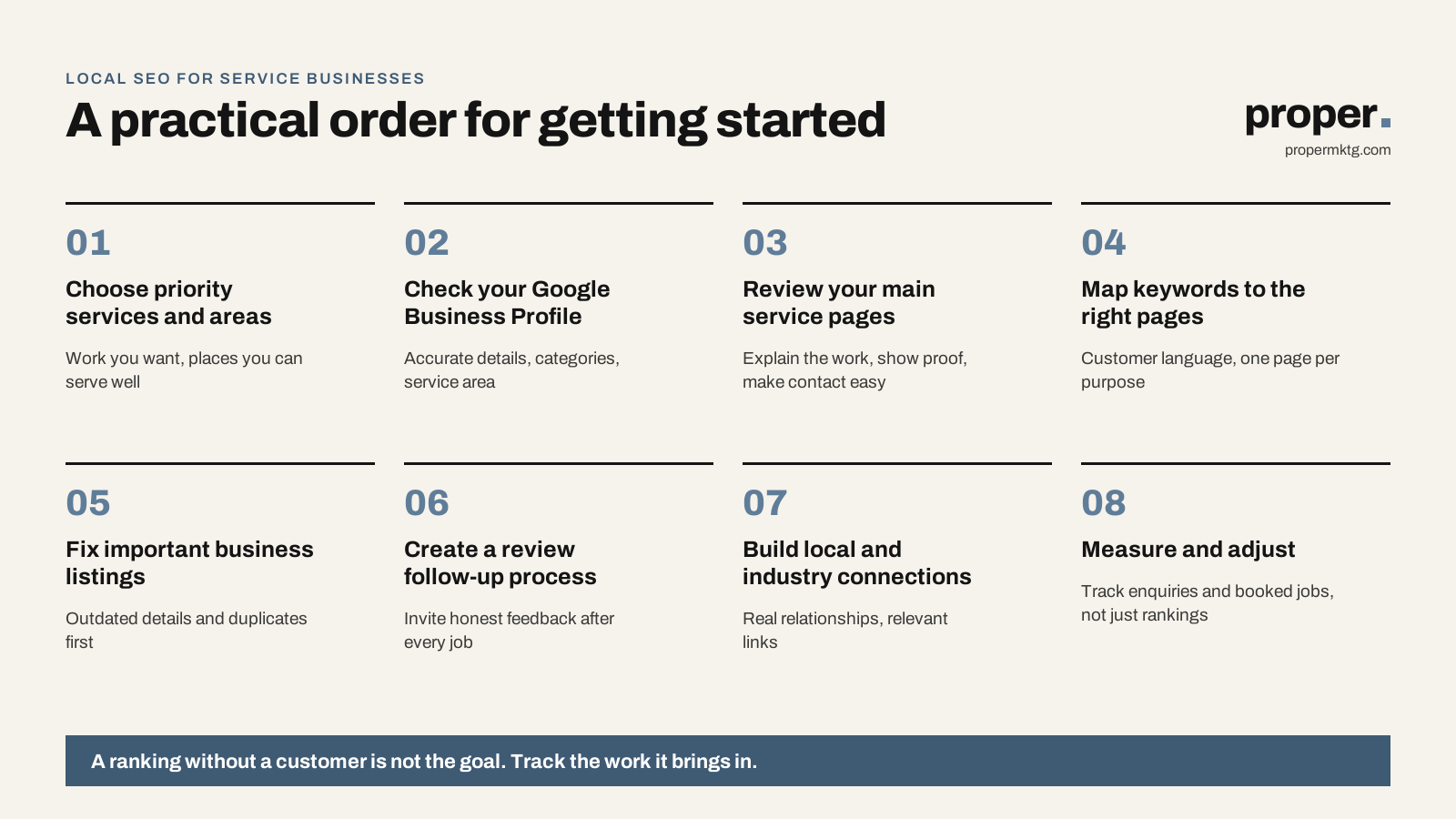
- Choose your priority services and locations. Focus on work you want and areas you can serve well.
- Check your Google Business Profile. Correct inaccurate information and complete relevant details.
- Review your main service pages. Make sure they explain the work, establish credibility and make contact easy.
- Map keywords to the right pages. Use customer language and avoid creating multiple pages for the same purpose.
- Fix important business listings. Start with outdated details and duplicates on relevant platforms.
- Create a review follow-up process. Invite honest feedback consistently.
- Develop relevant local and industry connections. Look for useful opportunities to be mentioned or linked.
- Measure and adjust. Use inquiry quality and booked work to guide your next decisions.
The same approach applies in Canada and the US, but the priorities depend on the market. Customer language, seasonal demand, competition and travel distances can vary considerably between cities. Research the places you actually serve before deciding what deserves your budget.
Thinking about getting help instead? Our guide to local SEO services in Canada covers what a sensible scope looks like and the questions to ask before you sign.
Help the right customers find your business with Proper
At Proper, we build local SEO strategies around your services, your market and the customers you want to reach. We connect keyword research, website improvements and Google Business Profile optimization with a clear purpose: helping potential customers find your business and take the next step.
You’ll understand what we’re working on, why it matters and how we’re measuring progress.
Want to know what could be holding back your local visibility? Book a free consultation with Proper to discuss your business and where to focus next.
Frequently Asked Questions
What is local SEO for service businesses?
Local SEO helps service businesses improve their presence in location-based search results. It involves your website, Google Business Profile, reviews, business listings and other signals that help customers find and evaluate your business.
Should every keyword include a city name?
No. City-specific searches are useful, but people also search using “near me,” service names and descriptions of their problems. Your keyword strategy should reflect those different searches, with location references used naturally where relevant.
Can I have a Google Business Profile without a storefront?
Yes, if your business meets Google’s eligibility requirements. Businesses that visit or deliver to customers can qualify as service-area businesses. If customers aren’t served at your address, that address should be hidden from the public profile.
Do I need a separate page for every city I serve?
No. Create a dedicated page when you can provide useful information specific to that location. A clear service-area page may be more appropriate than a collection of nearly identical city pages.
What’s the difference between a location page and a service-area page?
A location page focuses on one city or neighbourhood, with information specific to that area, like local projects or testimonials. A service-area page lists all the places you cover in one spot. If you don’t have something unique to say about each city, a single service-area page is usually the better choice.
Does local SEO guarantee more leads?
No. Local SEO can improve your visibility and create opportunities for inquiries, but results also depend on competition, customer demand, your offer and how effectively you convert and follow up with leads.