
Spend any time reading about marketing right now and you’ll run into three acronyms that seem to describe the same thing: SEO, AEO and GEO. They overlap, but each one covers a different part of how people find a business. Once you see where they split, it gets much easier to decide where your time and budget should go.
Here’s the short version: SEO gets you ranked, AEO gets you picked as the answer, and GEO gets you mentioned by AI. All three share one goal, which is being found. What changes is where people are looking when they search.
Below, we’ll walk through what each one is, how it works, when it matters most and its pros and cons. Then we’ll get practical about what you can do to show up better in each.
What is SEO (Search Engine Optimization)?
SEO is the work of helping your website rank in traditional search results: the familiar list of blue links you see on Google or Bing.
How it works: search engines crawl your pages, work out what each one is about, and judge how relevant and trustworthy it is for a particular search. A solid site, clear content and links from credible sources all push in the same direction: the stronger they are, the higher you tend to show up.
When it matters most:
- Someone is comparing options and wants to click through a few websites (“best roofing company in Surrey”)
- The search signals buying intent, and people expect to land on a website
- You want steady traffic that builds over time and doesn’t disappear when your ad budget runs out
Think of SEO as moving your store onto the busiest street in town. People still have to decide to walk in, but now they can actually see you.
What is AEO (Answer Engine Optimization)?
AEO is about getting your content chosen as the answer instead of appearing as one link among ten. It focuses on the places where a search engine or assistant responds to the question directly: featured snippets, “People also ask” boxes, voice assistants and quick answer panels.
How it works: answer engines look for content that addresses a specific question clearly and completely, ideally within the first few lines. When a page is built around real questions, with a short, direct answer followed by the detail, it becomes much easier for them to pull that answer out and display it.
When it matters most:
- Searches phrased as questions (“how long does a roof replacement take?”)
- Voice searches, where the assistant reads out a single answer
- Searches where people want a quick fact rather than a long article
If SEO puts you on the busy street, AEO makes you the shop people get pointed to when they stop and ask for directions.
What is GEO (Generative Engine Optimization)?
GEO is about being mentioned, summarized or cited when AI tools write an answer. Think ChatGPT Search, Perplexity, Google AI Overviews and Google’s AI Mode.
How it works: rather than showing a list of results, these tools read many sources and write their own response, often with a handful of links attached. For your business to make it into that response, the AI needs to understand exactly who you are and what you do, find content it can quote accurately, and see you referenced consistently across the web.
When it matters most:
- Research questions (“what should I look for in a renovation contractor?”)
- Comparisons and recommendations, where AI tools weigh up several options in one summary
- Audiences who already turn to AI tools first when they need an answer
For the bigger picture on why AI visibility belongs in a modern SEO plan, see What Small Business SEO Services Should Include in 2026. Here, the focus is on how GEO stacks up against the other two.
SEO vs AEO vs GEO at a glance
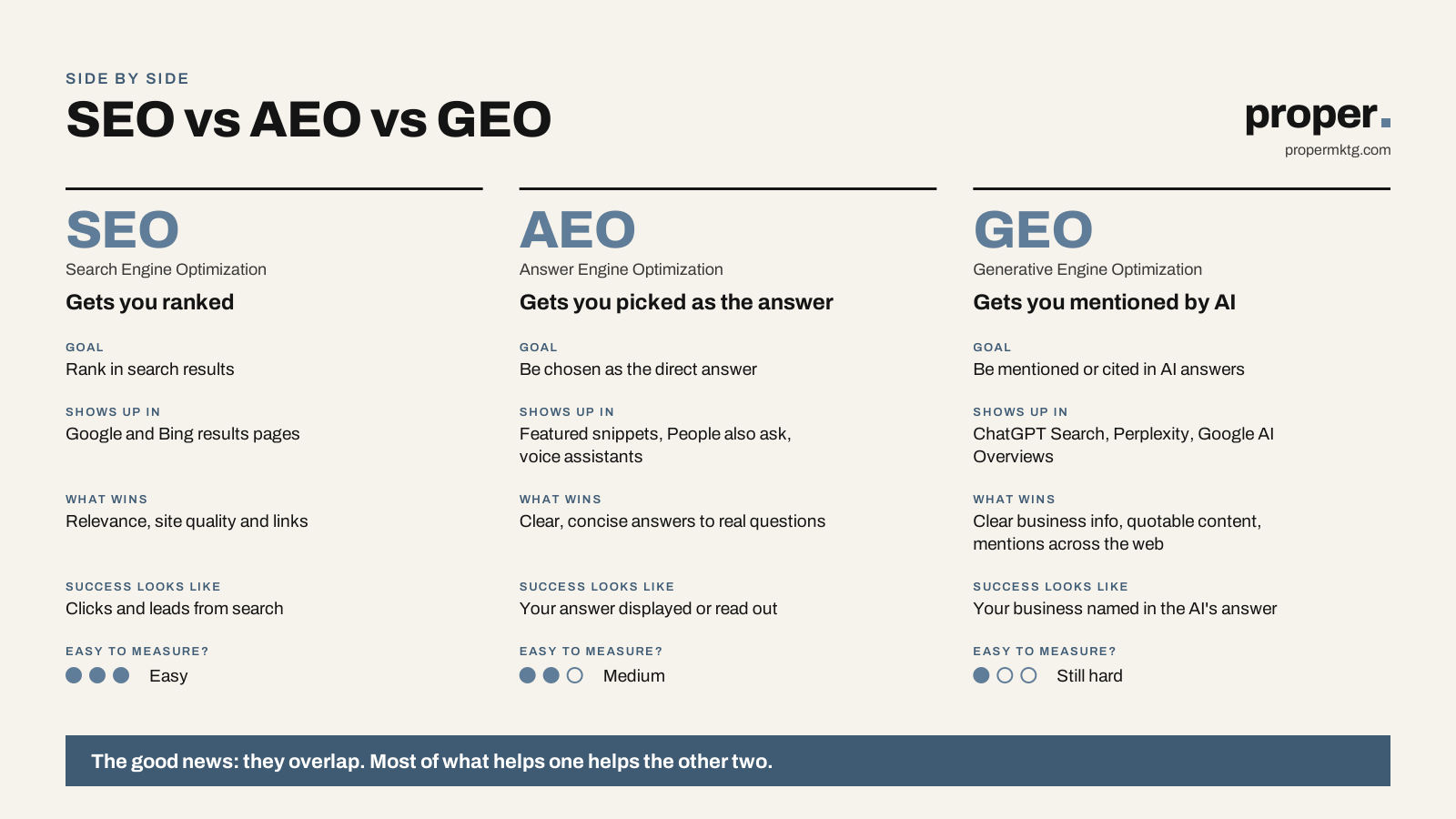
Pros and cons of each
SEO
Pros: it’s proven, it’s measurable, and it keeps paying off long after the work is done. A page that ranks well can keep bringing in leads for years.
Cons: results take time, competitive searches are tough to win, and more searches now end without a click because the answer already appears on the results page.
AEO
Pros: it puts you front and centre for question searches, builds your authority, and the same content often ends up feeding AI answers as well.
Cons: some people will read the answer and never visit your site. You earn the visibility, but not always the click.
GEO
Pros: it reaches people during the research stage, which is where trust gets built. When an AI tool names your business, it carries the weight of a recommendation.
Cons: it’s newer, harder to track, and you have less say in how the AI describes you. Nobody can guarantee a mention, so be cautious with anyone who promises one.
How to rank higher in each
Ranking higher in SEO
- Fix the foundation. Make sure Google can find and index your pages, and that your site loads quickly and works properly on a phone.
- Give every service its own page. A dedicated page for each service (and each area you serve, where it makes sense) beats a single page that tries to cover everything.
- Match what people actually search. Use the words your customers type into Google, not the jargon your industry uses internally.
- Earn mentions and links. Listings in local directories, plus mentions from partners, associations and the press, all signal to Google that your business is legitimate.
Ranking higher in AEO
- Start with the questions. Write down the questions customers ask you on the phone, then turn them into headings.
- Answer first, explain second. Place a direct answer of one or two sentences right below each question, then follow with the detail.
- Use FAQ sections and lists. Content organized into clear questions and lists is easier for answer engines to extract.
- Add FAQ and business schema. Structured data helps search engines understand exactly what each part of the page is for.
Ranking higher in GEO
- Be crystal clear about who you are. Describe what you do, where you do it and who you do it for, using the same wording on your website, Google Business Profile and social profiles.
- Write sentences worth quoting. AI can repeat specific, factual statements (“we serve Surrey, Langley and Delta”) much more accurately than vague slogans.
- Get talked about elsewhere. Reviews, directory listings, local news coverage and partner sites give AI tools more sources that back up what you do.
- Keep content fresh. Pages with outdated information are less likely to be trusted or cited, so review and update them regularly.
Notice the pattern? Content that is clear, honest and well organized helps you in all three places at once.
Which one should you focus on first?
For most small businesses, the answer is SEO first, with AEO and GEO built in from day one. There’s no need for three separate strategies or three separate budgets.
The reason is simple: AI tools and answer engines still rely heavily on solid, trustworthy websites. If your site is slow, confusing or light on content, no amount of “AI optimization” will make up for it. Get the foundation right and write your pages so they answer real questions directly, and you’re already covering most of what AEO and GEO ask for.
That said, a few situations call for a slightly different emphasis:
- If your customers search with questions, lean a little more into AEO with content built around FAQs.
- If your customers do a lot of research before buying, give GEO extra attention by building up reviews and mentions and making your service descriptions as clear as possible.
- If you’re brand new online, focus on SEO basics and your Google Business Profile before anything else.
Where Proper fits
At Proper, we don’t package SEO, AEO and GEO as three separate products. We treat them as one plan: a website that search engines understand, answer engines can quote and AI tools trust enough to mention.
Our approach is simple and transparent. We’ll show you where you stand, what to fix first and how we’ll measure progress, all in plain language and without promising guaranteed rankings.
Frequently Asked Questions
What is the difference between SEO, AEO and GEO?
SEO helps your website rank in search results. AEO helps your content get chosen as the direct answer in snippets and voice search. GEO helps your business get mentioned or cited when AI tools like ChatGPT or Google AI Overviews write an answer.
Is SEO dead because of AI?
No. AI tools still depend on solid, trustworthy websites to find and verify information. SEO is evolving, but it remains the foundation that AEO and GEO are built on.
Do I need separate strategies for AEO and GEO?
Usually not. For most small businesses, a strong SEO plan that clearly answers real customer questions already covers most of AEO and GEO. Depending on how your customers search, you might lean a little more into one of them.
How do I know if my business shows up in AI answers?
The easiest way to check is to ask the tools yourself. Search for your service and city in ChatGPT, Perplexity and Google, then see whether your business is mentioned and whether it’s described correctly.
Can anyone guarantee I’ll be mentioned by ChatGPT or Google AI?
No. Nobody controls how AI tools choose their sources. What you can control is making your business easy to understand, easy to quote and well referenced across the web.