
Ask five agencies what their SEO package includes and you will get five different answers. Some quote a monthly number and call it “SEO.” Others send a twelve-page proposal that never actually says what gets done each month. For a small business owner without an in-house marketing team, that gap between the sales pitch and the deliverable is the hardest part to judge.
Here is a practical way to read any SEO proposal. The work below is what legitimate small business SEO services should include in 2026, why each piece matters, and what to ask before you sign anything. If a provider cannot speak to most of these items, you are not buying SEO. You are buying activity.
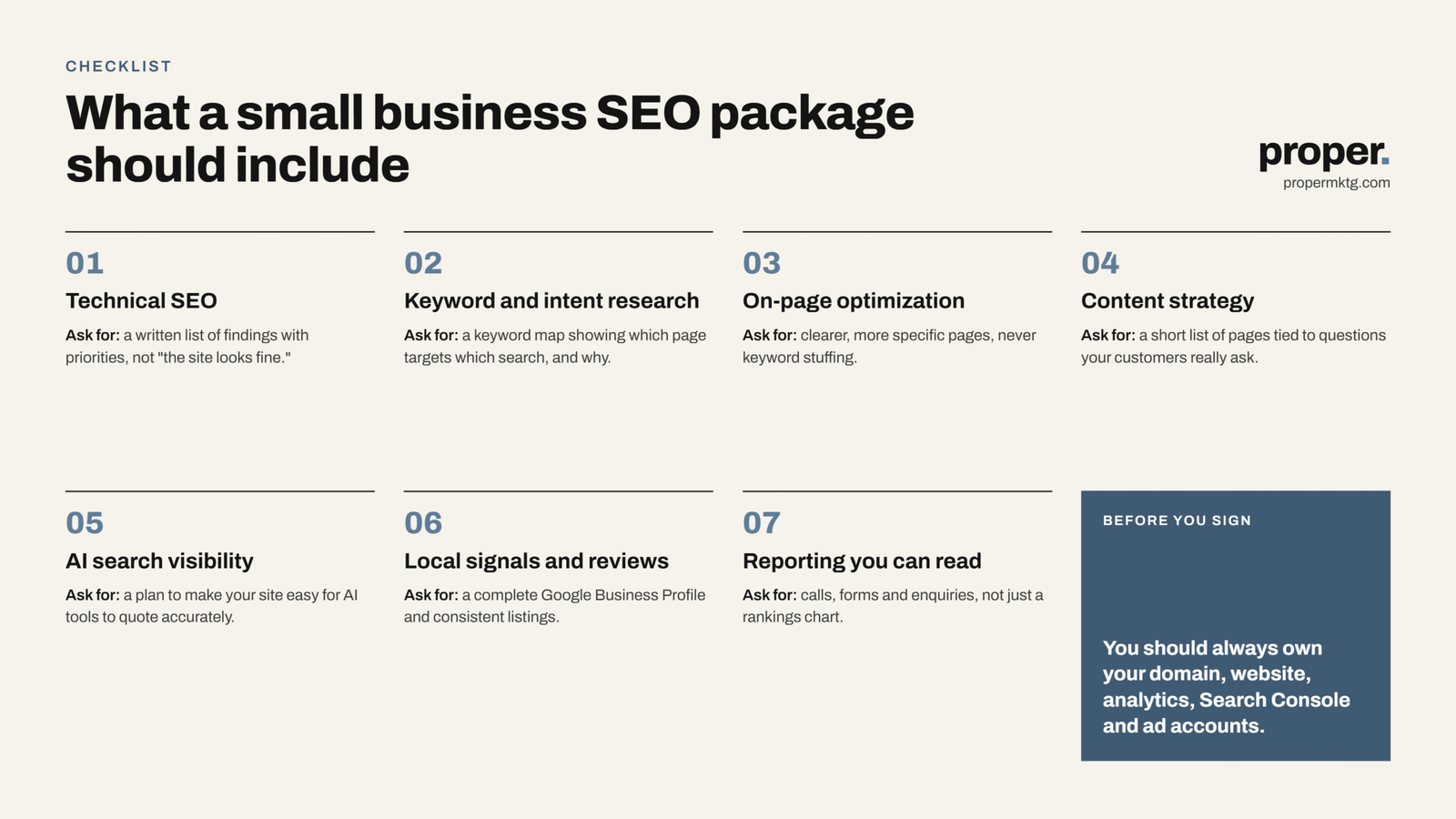
Technical SEO, Because Everything Else Sits on Top of It
Technical SEO is the unglamorous foundation work. Before content or links can do much good, search engines need to find, crawl, and index your pages without confusion. A small site can carry serious technical problems and still look fine to a visitor, which is exactly why this step gets skipped by providers who prefer visible busywork.
A proper technical review covers:
- Indexation status, including pages that are blocked, duplicated, or accidentally excluded from search
- Site speed and mobile performance, since many local searches happen on a phone
- Broken links, redirect chains, and outdated redirects left over from an old website
- Canonical tags, sitemap accuracy, and internal link structure
- Secure connection and correct URL structure across the site
- Structured data that helps search engines understand your services, locations, and business details
You should receive this as a written list of findings with priorities, not a vague assurance that “the site looks technically fine.” If your provider does not have access to your website platform and your analytics, they cannot complete this step at all.
Keyword and Search Intent Research
Keyword research for a small business is not about finding the highest-volume terms. It is about finding the searches your actual customers make, then understanding what they want when they make them. Someone searching a service name is often ready to hire. Someone searching a question is still learning. Those two visitors need different pages.
A good research phase produces a keyword map: which terms you are targeting, which page targets each one, and how the intent behind each term shaped the decision. It also accounts for local modifiers, since a search that includes your city or region behaves differently from a national one. Watch for a provider who promises rankings for a list of broad terms with no local or intent logic behind them.
On-Page Optimization Done Properly
On-page work is where keywords meet your existing pages. It includes title tags, headings, meta descriptions, image alt text, internal links, and the clarity of the copy itself. Done well, it usually means modest edits across many pages rather than a rewrite of your whole website.
There is a real risk of overcorrecting here. Stuffing a service keyword into every paragraph makes a page worse for the people reading it, and search engines are increasingly good at spotting it. On-page optimization should make each page more specific and more useful, not more repetitive. If you read a revised page and cannot tell what it promises in the first few sentences, the editing went in the wrong direction.
Content Strategy That Answers Real Questions
Content is where small businesses tend to either overspend or underspend. Publishing three blog posts a week that nobody searches for is wasted effort. Having no page for a service you actually sell is a missed opportunity that costs you leads every month.
The right content plan starts with the questions your customers already ask you by phone, email, or in person. Those questions become service pages, comparison pages, and supporting articles. It also includes maintaining what you already have: updating outdated information, consolidating thin pages that compete with each other, and improving pages that rank but do not convert. A content strategy should be a short list tied to specific pages, with a reason for each one.
AI Search Visibility
This is the piece that separates a 2026 SEO service from a 2021 one. More people now get answers from AI tools such as ChatGPT Search, Perplexity, and Google AI Overviews instead of scrolling a list of links. Those systems summarize and cite sources, which changes what visibility looks like.
Visibility in AI answers depends on being clearly understood as a business, having content that answers a question directly and completely, and being referenced by other credible sources. In practice that means clean page structure, plain-language service descriptions, consistent business details across the web, and content written so a machine can lift a correct sentence out of it. No provider can guarantee placement in AI answers, and any agency promising that should be treated with caution. What you can ask for is a plan to make your site easier to quote accurately.
Local Signals, Reviews, and Business Listings
For most small businesses, local search is where the leads live. This side of SEO covers your Google Business Profile, your name, address, and phone details as they appear across directories and review sites, and the reviews themselves. Inconsistent business information creates doubt for both customers and search engines.
Your provider should be able to explain how they handle listing consistency, how they encourage reviews, and whether location or service area pages make sense for your business. This is also a task you can share. Responding to reviews is yours, because you know the customer.
Measurement and Reporting You Can Actually Read
Reporting is where trust is either built or lost. Rank tracking alone tells you very little, because a ranking without traffic or enquiries is not a business result. You want reporting that connects to outcomes: organic sessions, calls, form submissions, and the pages that produced them.
Ask for the specific metrics, the reporting frequency, and who owns the analytics and advertising accounts. Ownership matters. If your agency holds the accounts and you part ways, you should not have to rebuild your own data from scratch. Analytics and Search Console access should sit with you from day one.
What SEO Services Cost, and Why the Range Is So Wide
Agency pricing varies enormously across Canada and the United States. One provider might charge a few hundred dollars a month, another several thousand, and both can be describing something they call “SEO.” That gap is not evidence that one price is fair and the other is not. It usually reflects how differently agencies define scope, along with your market, your competition, and the condition of your website.
Rather than shopping on price, ask what the fee covers: how many hours, which tasks, who does the work, and what happens in month four when the initial technical fixes are finished. Also ask about the contract term. A free consultation before any commitment is a low-risk way to test whether the person explaining SEO can do it in plain language. Proper offers free consultations through its contact page for exactly that reason.
What to Ask Before You Sign
Bring these questions to any proposal review, and pay attention to how comfortably the provider answers them:
- What specifically happens in the first 30 days, and in month six?
- Which pages will you change, and why those pages?
- Who owns the website, analytics, and advertising accounts?
- How will you report results, and how often?
- What do you do about AI search tools, not just traditional rankings?
- What is the notice period if I want to stop?
- Will you tell me when something is not working?
An SEO provider who cannot answer those questions clearly is asking you to buy a feeling rather than a service. Honest ones will also tell you what SEO cannot fix, such as a product nobody wants or a website that fails at checkout. Proper’s approach is built on that kind of transparency: strategy first, plain language, defined scope, and no promises of guaranteed rankings.
Frequently Asked Questions
There is no reliable standard price in Canada or the US. Fees range from a few hundred to several thousand dollars a month, because agencies define scope differently and every market has its own level of competition. Compare what each fee includes rather than the headline number, and confirm the details in writing before committing.
Timelines depend on your competition, the current condition of your website, and how much work is in scope. No provider can honestly promise a specific ranking or a specific date. What you can reasonably expect is a clear picture of what is being fixed first and how progress will be measured along the way.
AI search visibility means your business shows up accurately when people get answers from tools such as ChatGPT Search, Perplexity, or Google AI Overviews instead of clicking through a list of links. It is worth attention because a growing share of searches now ends there. No agency can guarantee placement in those answers.
Not necessarily, but the two work well together when the same team understands your keywords and your website. Paid search can generate enquiries while organic rankings build, and the keyword data from ads is useful for SEO planning. If you use two providers, make sure they are not bidding against each other or duplicating work.
You should own your domain, website, analytics, Search Console, advertising accounts, published content, and historical data. Ask this before signing, and confirm it in the agreement. If a provider refuses to hand over access or data, that is a strong signal to look elsewhere, regardless of how impressive their reporting looks.
Not Sure What Your Business Actually Needs?
If you are comparing proposals, or you are not sure whether your current provider is covering the basics, we can help you sort it out. Book a free consultation with Proper and we will walk you through what your website and search presence need first, in plain language and with no pressure to sign.